

Top Data Engineering Trends and Technologies Shaping 2025
Introduction Data engineering has evolved from simple ETL (Extract, Transform, Load) jobs to an advanced ecosystem of cloud-native pipelines, real-time analytics, and AI-driven automation. As data becomes the backbone of digital transformation, new tools and technologies are redefining how organizations collect, process, and leverage information. This post explores the biggest data engineering trends and technologies of 2025 that every tech team and data professional should keep an eye on. 1. Rise of Real-Time Data Pipelines Batch processing is no longer enough. Businesses now demand real-time insights to make instant decisions. Tools like Apache Kafka, Flink, and Spark Structured Streaming are leading the way, enabling continuous data ingestion and analysis from multiple sources. Trend Insight:Real-time architecture is becoming the new standard, especially for fintech, e-commerce, and IoT-driven industries. 2. DataOps and Automation Take Center Stage DataOps, often called the DevOps for data, focuses on streamlining data workflows through automation and collaboration.

Data Analysis with Python: Build Your First Dashboard Using Pandas and Plotly
A Step-by-Step Beginner’s Guide to Visualizing and Exploring Data Interactively Introduction Data is one of the most valuable assets in any business today, but raw data alone doesn’t tell a story.That’s where data analysis and visualization come in. In this guide, we’ll explore how to analyze data in Python and build your first interactive dashboard using Pandas and Plotly, two of the most popular tools in the data analytics world.By the end, you’ll also learn how to deploy it online using Streamlit, so others can interact with your insights in real time. What You’ll Learn Here’s what we’ll cover: Step 1: Setup Your Environment Before we dive in, make sure Python is installed on your system.Next, install the required libraries: Step 2: Prepare a Sample Dataset Let’s use a simple sales dataset. Save this as sales_data.csv: This represents daily sales of different products. Step 3: Load and Clean Your Data
Data Analyst vs. Data Scientist: Clearing the Confusion in Data Careers
In the fast-growing world of data, roles are evolving quickly. Two titles you’ll often hear are “Data Analyst” and “Data Scientist.” They’re sometimes used interchangeably but are they really the same? Let’s break it down, clear up the confusion, and understand how each role fits into the modern data-driven landscape. What is a Data Scientist? A Data Scientist is often seen as the problem-solver who works at the intersection of statistics, machine learning, and programming. Their job goes beyond just looking at data they build predictive models and create systems that can learn patterns. A Data Scientist typically:• Cleans and processes raw datasets.• Builds machine learning models for forecasting, recommendations, or classifications.• Uses programming languages like Python, R, or Julia.• Works on big data platforms and cloud solutions.• Helps companies predict future trends using advanced algorithms. Think of them as architects who design intelligent solutions that transform data into actionable
MySQL: Entity-Relationship Model
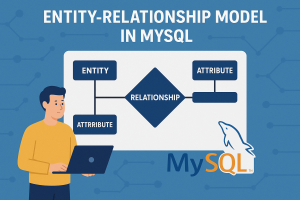
Entity-Relationship model or E R model is used to create a relationship between different attributes or entities. It describes the structure of the database with the help of the ER Diagram or Entity Relationship Diagram. ER model creates a simple design view of the data that makes the data easier to understand. Example: Here, we have a database COMPANY, and in this database, EMPLOYEE is the entity (table). The employee entity contains several attributes like EMP_ID, EMP_NAME, EMP_ADDRESS, EMP_DATE_OF_BIRTH, EMP_AGE, and EMP_CONTACT. ER Model Components 1. Entity The entity in DBMS can be a real-world object having conceptual reality and existence. Example: In a COMPANY database, the entity type is EMPLOYEE. Here employees are real-world persons that have some existence. Entity Types Strong Entity Entities that don’t depend on other entities. Contains a primary key. Represented by a single rectangular box. Example: EMPLOYEE with EMP_ID as primary key. Weak Entity